
Transform Your Home with Professional Baseboard Installation
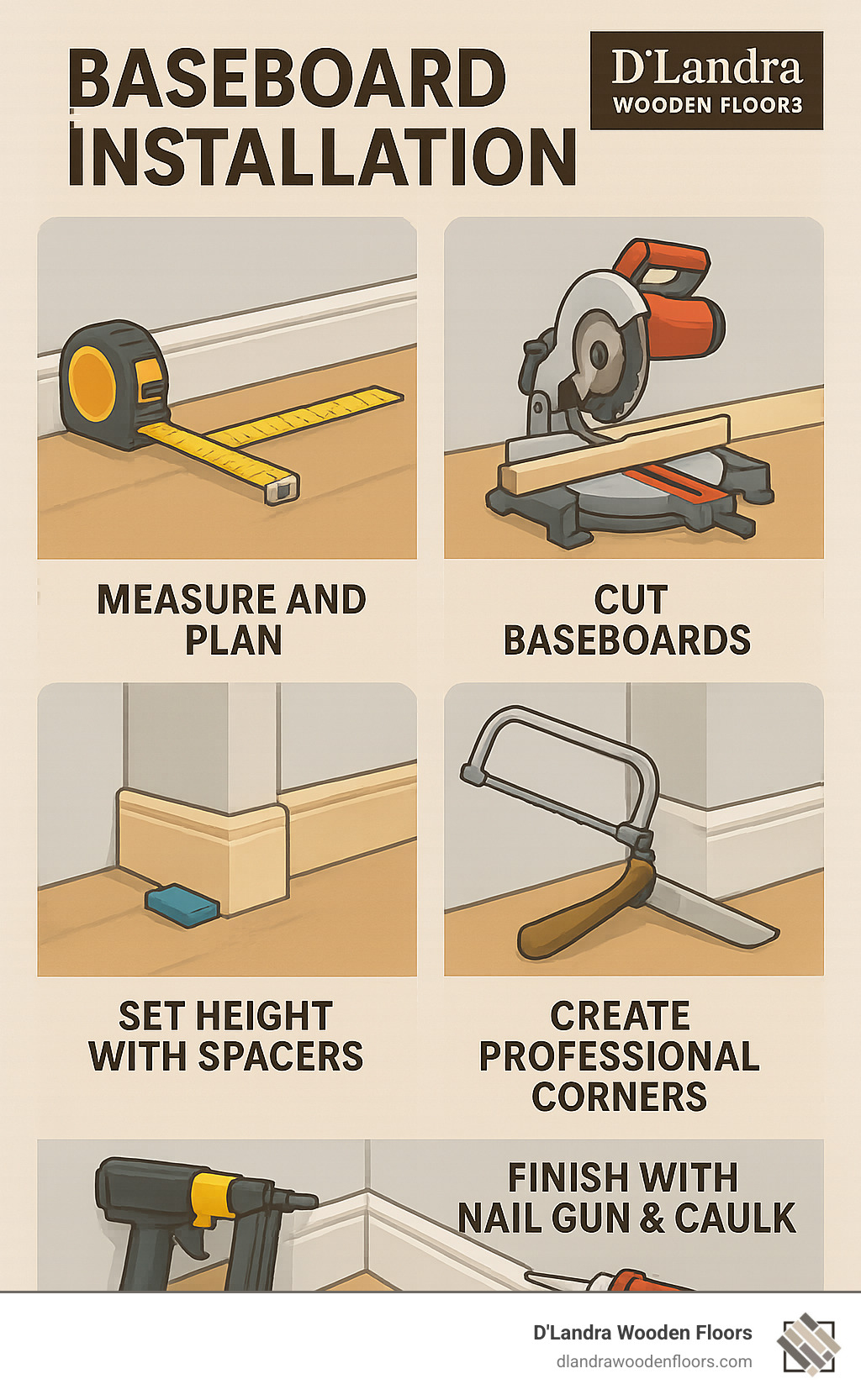
Baseboard installation is a simple yet transformative project that adds both style and functionality to any room in your home. For quick reference, here are the 5 essential steps:
- Measure and plan – Calculate linear footage plus 10% extra for waste
- Cut and pre-finish – Use miter saw for corners and pre-paint for easier finishing
- Set proper height – Maintain 3/8″ to 5/8″ gap above subfloor for carpet or use spacers
- Create professional corners – Cope inside corners and miter outside corners at 45°
- Secure, seal, and finish – Nail to studs every 16″, caulk top edge, fill holes, and paint
Despite their lowly position along the floor, baseboards are one of a home’s defining features. They serve multiple important purposes: covering the gap between your flooring and wall, protecting walls from damage, and providing a finished, polished look to any room. Whether you’re renovating, replacing old trim, or building new, properly installed baseboards can lift your home’s interior from ordinary to neat.
The average baseboard installation costs between $6 and $9 per linear foot, with a typical 100-150 linear foot project totaling $400-$1,500. While not technically difficult (rated 1 out of 5 for skill level), the process requires patience and attention to detail, especially when cutting precise angles for corners.
As Tom Silva, master carpenter, notes, “If baseboards have stature, a room becomes regal.” With the right tools and techniques, you can achieve professional-looking results whether you choose simple, modern profiles or more elaborate, traditional designs.
Step-by-Step Baseboard Installation Guide
At D’Landra Wooden Floors, we’ve installed countless baseboards alongside our premium hardwood and vinyl plank flooring throughout South Florida. Our experience has taught us that successful baseboard installation comes down to proper planning, the right tools, and attention to detail. Let’s walk through this process together, breaking it down into manageable steps.
Step 1: Pre-Install Planning for Successful Baseboard Installation
Before you purchase a single piece of trim, taking time to plan will save you money, frustration, and those dreaded extra trips to the hardware store.
Start by measuring the perimeter of each room where you’ll install baseboards. Add these measurements to get your total linear feet, then add 10-15% extra for waste, mistakes, and future repairs. For perspective, a typical 12′ × 12′ room with a closet needs approximately 58 linear feet, plus about 6 feet of overage material.
You’ll need several tools for a smooth installation: a tape measure, pencil and notepad, stud finder, miter saw (or manual miter box), coping saw, 4-foot level, utility knife, pry bar for removing old trim, hammer, brad nailer, caulking gun, 120-grit sandpaper, and safety equipment including glasses and ear protection.
Preparing your space properly is crucial. Score the painted edge where old baseboards meet the wall with a utility knife, then carefully pry them away using a pry bar. Remove any lingering nails, clean the wall surface thoroughly, and allow your new baseboard material to acclimate indoors for 3-7 days before installation.
If you’re planning to install carpet, baseboards should go in first but raised 3/8″ to 5/8″ above the subfloor to allow carpet and padding to tuck underneath. For hardwood or vinyl floors, baseboards typically go in after the flooring is complete.

Step 2: Cut & Pre-finish Boards Like a Pro
The right cutting and preparation techniques will give you cleaner joints and a more professional finish.
When selecting materials, you have several options. Medium-density fiberboard (MDF) costs $1.00-$3.50 per linear foot and offers consistency and resistance to warping. Wood options like pine, oak, or poplar run $1.00-$10.00 per linear foot and can be stained or painted for a natural look. PVC/vinyl baseboards ($0.50-$5.00 per linear foot) provide moisture resistance, making them perfect for bathrooms.
Always wear safety glasses when cutting, and practice on 3″-4″ test pieces before working with your good material. For precision, cut baseboards slightly longer (about 1/16″-1/8″) than measured and fine-tune for a tight fit. Consider beveling the bottom edge at 2°-5° to make it easier to scribe to uneven floors.
Pre-finishing your baseboards saves tremendous time and frustration. Sand all boards with 120-grit sandpaper, apply primer to raw wood or MDF, and pre-paint before installation. Leave nail areas unpainted or lightly marked with pencil so you can find them easily. As our lead installer says, “Painting baseboards before installation prevents wall paint from getting on your trim and makes touch-ups easier after nailing.”
Step 3: Set Height & Install Before Flooring
Consistent height creates that professional look we all want, especially when dealing with uneven floors.
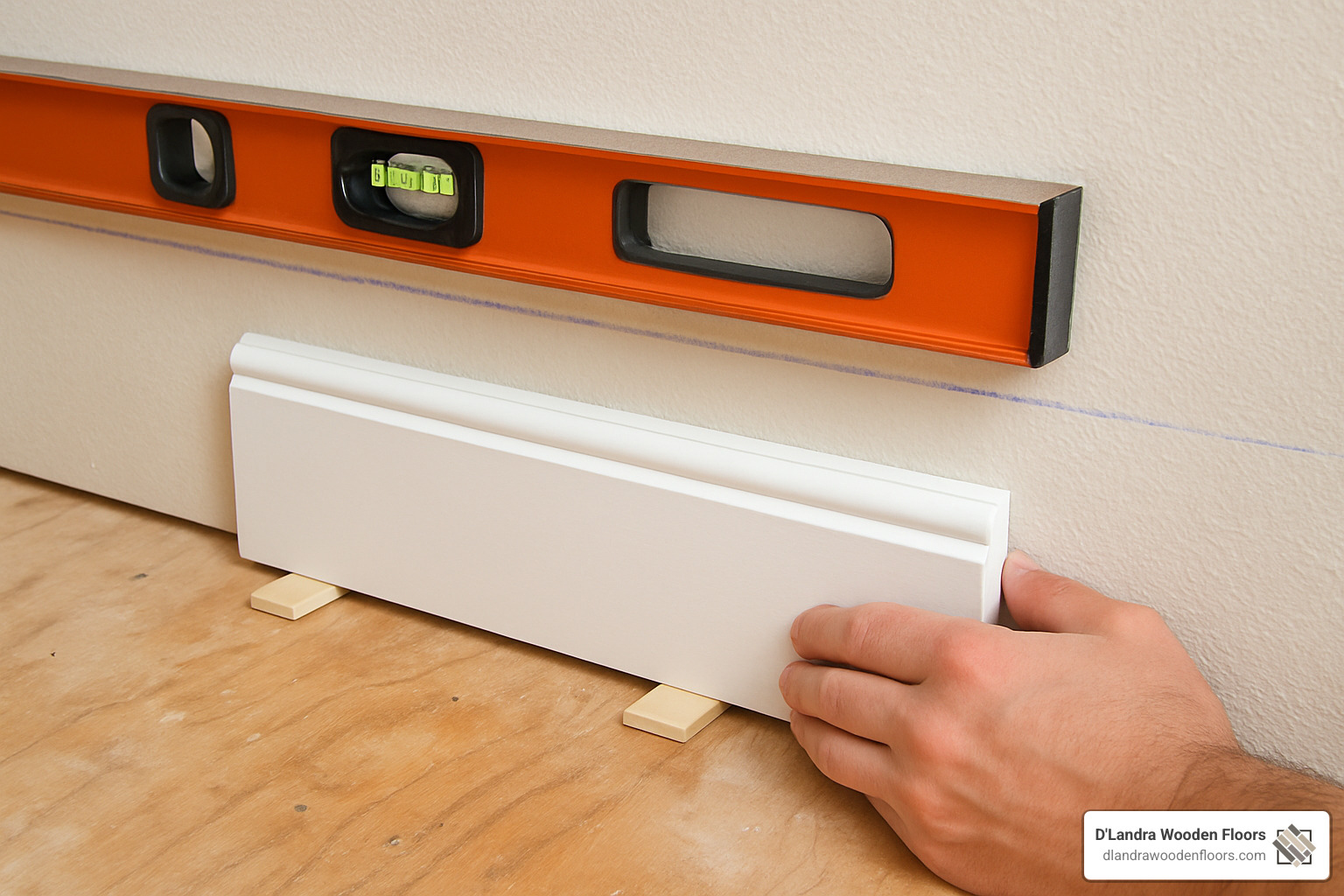
For carpet installation, maintain a 3/8″ to 5/8″ gap above the subfloor (1/2″ is standard). Scrap pieces of drywall make perfect temporary spacers. If you’re installing over hardwood or vinyl, baseboards should rest directly on the finished floor.
To create a level reference around the room, find the lowest point of the floor and place a scrap piece of baseboard there. Use a 4-foot level to mark a level line or snap a chalk line around the room at the height of the baseboard top. This reference ensures all baseboards align horizontally, regardless of floor irregularities.
When installing, start at inside corners and work toward outside corners. Some carpenters prefer working clockwise, while others take a wall-by-wall approach. The key is consistency—choose a method and stick with it.
For significantly uneven floors, use a compass to scribe the bottom of the baseboard to match the floor contour. Set the compass to the widest gap between baseboard and floor, hold the baseboard in position with spacers, and run the compass along the floor to mark the contour. Cut along this line, test fit, and adjust as needed.
Step 4: Corner Craftsmanship for Flawless Baseboard Installation
Corners can make or break the professional appearance of your baseboard installation. There are two types you’ll need to master: inside and outside corners.
For inside corners, the coping method produces the best results. Cut the first piece square (90°) and install it flush to the corner. For the second piece, cut a 45° miter to reveal the profile, then use a coping saw to cut along this profile line, removing material behind it. Create a slight back-bevel as you cope for a tighter fit. This method accommodates wall irregularities much better than simple miters.
Alternatively, you can use the simple miter method, cutting both pieces at 45° angles. While faster, this works best only on perfectly square corners—which are surprisingly rare in most homes.
For outside corners, the miter method works well. Cut both pieces at 45° angles to form a 90° corner, making cuts slightly long (1/16″) and fine-tuning for tight joints. Consider using wood glue between miters for strength. For high-end installations, you might use biscuit joint reinforcement by cutting matching slots in both mitered edges, applying wood glue, inserting biscuits, and clamping until dry.
When dealing with uneven or crooked walls, use a block plane to shave the back edge of baseboards that don’t sit flush. For severely uneven walls, consider using more flexible, thinner baseboards. Fill larger gaps with backer rod before caulking. And remember, in older homes, some irregularities add character—don’t chase perfection.
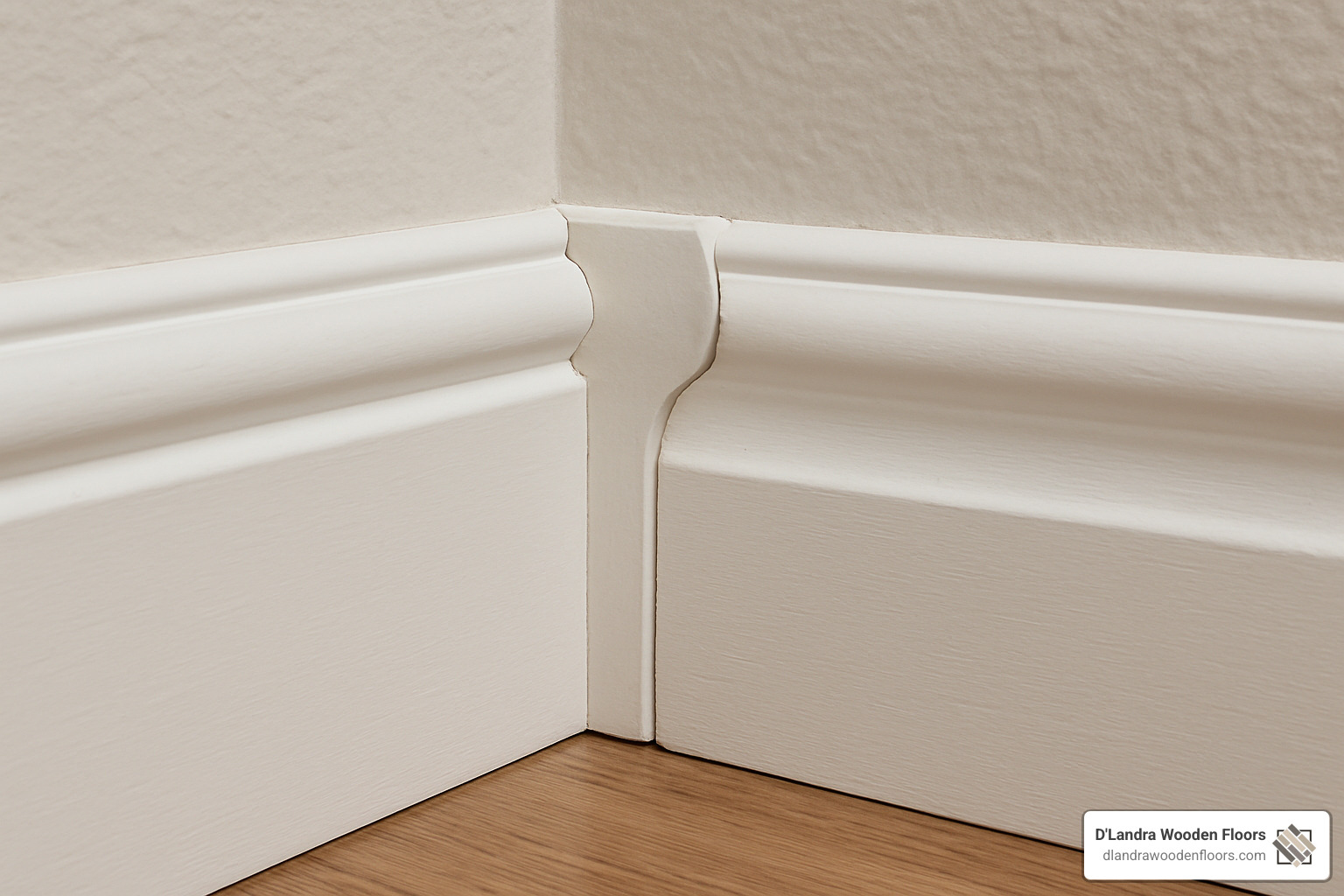
When it comes to the direction of installation, two approaches exist: the Production Method (California School) focuses on efficiency, installing pieces in sequence based on wall length, while the British/Canadian Method plans each room individually, placing coped joints where they’ll be least visible. At D’Landra Wooden Floors, we recommend walking the room first and planning piece placement based on sightlines.
Step 5: Secure, Seal & Touch-Up Finish
The final step in baseboard installation transforms good work into great work through proper securing, sealing, and finishing.
To secure your baseboards, locate and mark wall studs (typically 16″ on center). Use a pneumatic brad nailer with 2″ 18-gauge nails for standard 5/8″ drywall. In areas with pipes or thin drywall, switch to 1½” nails to avoid damage. Place nails at the top and bottom of the baseboard approximately every 16″, angling them slightly downward for better holding power. For areas without studs, add construction adhesive for extra security.
Sealing edges properly creates that seamless look. Apply a thin bead of paintable caulk along the top edge where baseboard meets wall. For gaps larger than 1/4″, insert backer rod before caulking, then smooth the caulk with a wet finger or caulk tool. In moisture-prone areas like bathrooms and kitchens, use silicone caulk. Generally, avoid caulking the bottom edge of baseboards to allow for natural expansion and contraction.
For those finishing touches, fill nail holes with wood filler or spackling compound. Let dry completely, sand smooth with fine-grit sandpaper, and touch up paint on nail holes and scuffed areas. Apply a final coat if needed, and remove any painter’s tape while paint is still slightly wet for clean lines.
To keep your baseboards looking fresh, clean them regularly with a damp cloth to prevent dust buildup. Touch up paint as needed, especially in high-traffic areas, and check caulk lines annually, repairing any cracks or separations. For wood baseboards, monitor for warping or shrinkage due to humidity changes.
“For a truly professional finish,” explains our design consultant, “we recommend installing shoe molding after baseboard installation, especially with hardwood floors. This small detail covers any gaps between the baseboard and floor while adding a neat finishing touch.”
Costs, FAQs & Next Steps
Thinking about baseboard installation for your home? Let’s talk about what it’ll cost you and answer those burning questions you might have before getting started.
Most homeowners are surprised to learn that baseboard installation costs typically range from $6 to $9 per linear foot when professionally installed. For perspective, an average home with 100-150 linear feet of baseboards would total about $400-$1,500. The good news? If you’re handy and patient, tackling this as a DIY project can save you roughly 50-60% of that cost.
When it comes to time investment, professionals work efficiently—installing about 20 linear feet per hour. This means a pro can finish an average home in about 5-7.5 hours. DIYers should plan for a weekend project, typically taking 10-14 hours depending on your experience and how many tricky corners you encounter.
Let’s compare materials to help you make the best choice for your home:
| Material | Cost Per Linear Foot | Pros | Cons |
|---|---|---|---|
| MDF | $1.00-$3.50 | Consistent, smooth, paintable, affordable | Not moisture-resistant, can’t be stained |
| Pine | $1.00-$4.00 | Natural look, can be stained or painted | May dent easily, can warp with humidity |
| Oak/Hardwood | $3.00-$10.00 | Durable, premium look, stainable | More expensive, harder to cut |
| PVC/Vinyl | $0.50-$5.00 | Waterproof, consistent, low maintenance | Limited styles, artificial appearance |
“We often recommend MDF for most South Florida homes,” says our installation manager. “It stands up well in our climate and takes paint beautifully, giving you that crisp, clean look that’s so popular right now.”
Homeowners always have questions about baseboard installation, so let’s address the most common ones:
Wondering whether to paint before or after installation? For DIY projects, painting beforehand is much easier—you’ll get cleaner lines and only need to touch up nail holes afterward. Professional painters might prefer painting after installation, especially when spray-painting for a flawless finish.
If you’re installing carpet soon, remember to position your baseboards 3/8″ to 5/8″ above the subfloor. This gap allows the carpet and padding to tuck neatly underneath. Most installers use a standard 1/2″ gap as a reliable rule of thumb.
Dealing with uneven walls? Don’t worry—this is completely normal, especially in older homes. Good installers use techniques like back-beveling edges, using backer rod behind caulk for larger gaps, or carefully scribing baseboards to match wall contours. These little tricks make a huge difference in the final appearance.
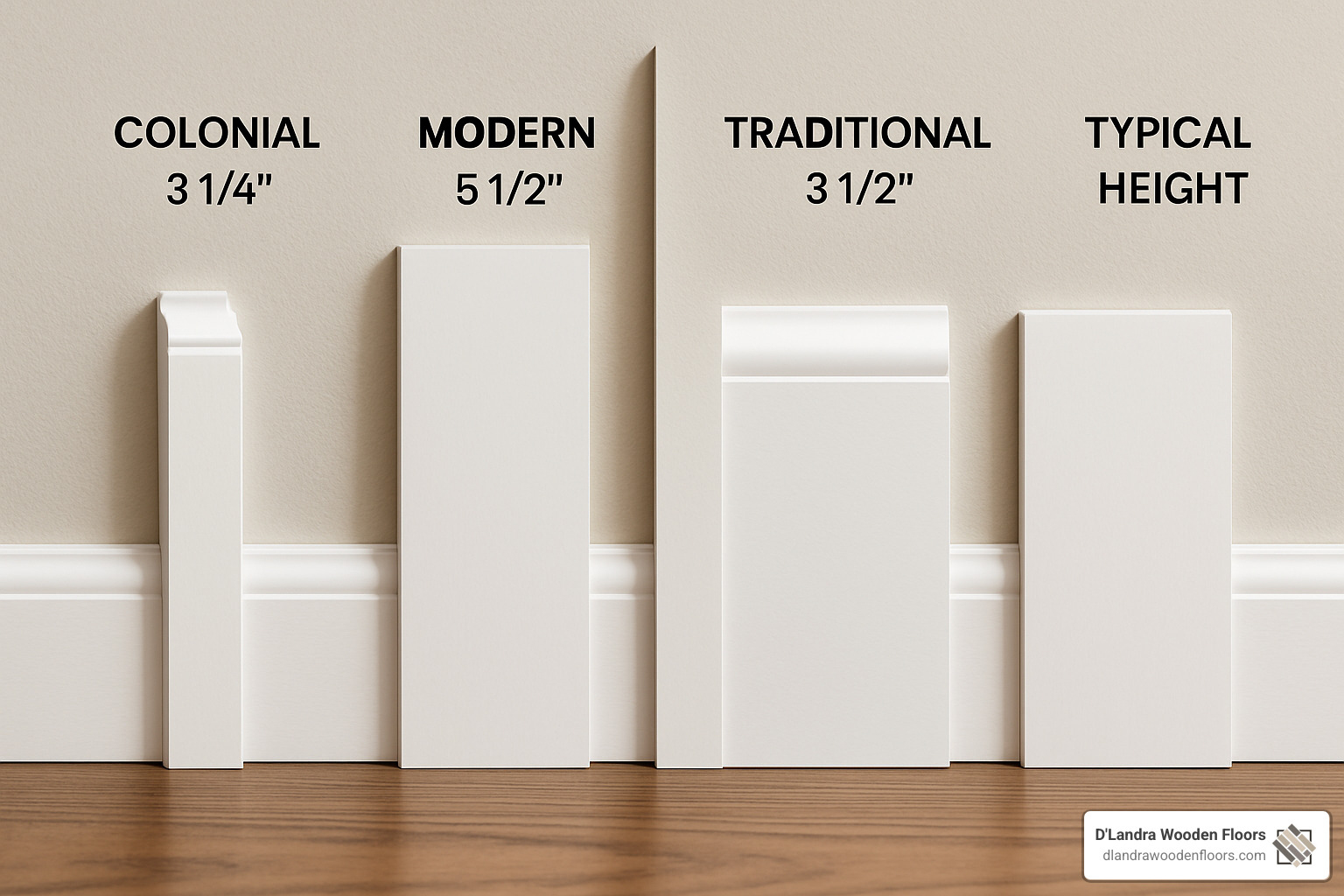
As for baseboard height, the current trend leans toward taller baseboards—5″ to 7″ is quite popular. However, a good designer’s rule is to choose baseboards approximately 7% of your ceiling height. For standard 8′ ceilings, that’s about 5¼” tall baseboards.
Budgeting & Hiring Pros for Baseboard Installation
While many homeowners in Coral Springs, Parkland, and throughout South Florida enjoy DIY projects, baseboard installation is one area where professional help often makes sense—especially when coordinating with new flooring installation.
Several factors affect your final cost. Room complexity plays a big role—more corners mean more complex cuts and more time. The baseboard style matters too; ornate profiles with multiple curves and details take longer to install properly. Wall and floor conditions can add to costs if repairs are needed, and removing old baseboards adds about $50-$100 per hour to the project. Finally, if you’re purchasing unfinished baseboards, painting adds $1-$4 per linear foot to your budget.
Looking to save money without sacrificing quality? Remove old baseboards yourself before the installers arrive. This dusty, somewhat tedious job can save you hundreds. Also, consider purchasing materials directly from suppliers to avoid markup, and choose simpler profiles that install more quickly. MDF is an excellent budget choice for painted baseboards, and try to schedule your baseboard installation alongside other trim work for better contractor rates.
“The most important thing is finding the right installer,” explains our customer service manager. “The right questions can help you identify true professionals.” Before hiring anyone, ask:
How long have you been installing trim? Look for at least 3-5 years of experience.
Are you licensed, insured, and bonded? This protects you and your home.
What material do you recommend for my project and why? Their answer reveals their expertise.
How do you handle uneven walls or floors? Experienced installers have specific techniques.
Do you offer a warranty? Quality work should be guaranteed.
Professional installers bring specialized tools, years of experience with challenging situations, and the craftsmanship to create those perfect corners and joints that lift your home’s appearance. At D’Landra Wooden Floors, our installation teams throughout South Florida excel at coordinating baseboard installation with our premium flooring services, ensuring a seamless transition between floors and walls.
“The difference between DIY and professional installation often comes down to the details—those perfectly coped inside corners and consistent reveals that make your new flooring look even better,” notes our lead installer with a smile.
Ready to get started? Here’s what to do next: First, measure your space to determine linear footage needed. Then, decide on your preferred baseboard style, height, and material. Consider whether you’ll DIY or hire professionals based on your skill level, tools, and available time. If hiring pros, always get at least three written estimates for comparison. Finally, schedule installation after flooring but before moving furniture back into the room.
At D’Landra Wooden Floors, we provide free in-home estimates for both flooring and baseboard installation throughout South Florida. Our fully insured services ensure your project is completed with precision, durability, and attention to detail.
Whether you’re installing new hardwood floors or upgrading your home’s trim, properly installed baseboards provide the perfect finishing touch that transforms your space from ordinary to extraordinary. With these five easy-to-follow steps, you’ll achieve professional results that improve your home’s beauty and value for years to come.
More info about flooring services